
Introduction

Background Rationale
Local hospitals possess world-class medical staff, technologies, and clinical infrastructures. Moreover, environment for the local hospitals is outstanding to plan researches on the sector without available treatments by using accumulated clinical experience and develop and verify the technologies needed in the clinical setting. However, identified limitations are hospitals’ excessive dependence on clinical revenue and deficient collaboration with the outside. Accordingly, the government carried out the research-driven hospital project to support the basic research and commercialization of the healthcare sector by using the advantages of hospitals.
Research-driven Hospital Project
Hospitals with advanced R&D capabilities are designed and fostered to facilitate R&D environment change in the hospitals with the healthcare R&D outcomes enhanced, which contributes to the health improvement of the people who are end users.
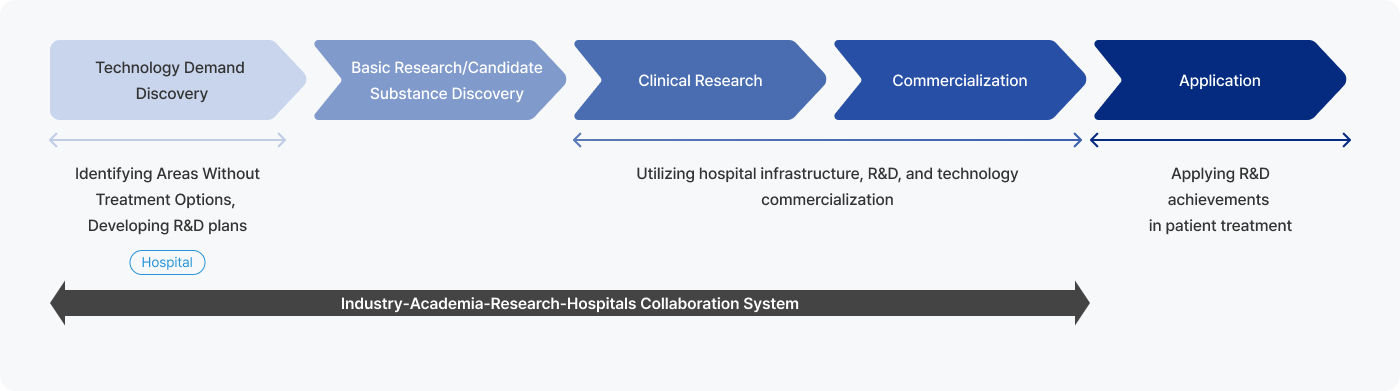
Concept of a research-driven Hospital
The hospital establishes the virtuous cycle of R&D, intermediation and clinical research, commercialization, product development, and clinical consultation as the key actor of Healthcare Technology Innovation (HT Innovation) to enhance medical service and improve healthcare quality.
- Certified the 21 medical institutions* with research capability as research-driven hospitals to build the industry-university-institute open collaborative research infrastructure (March 2025, based on the Health and Medical Technology Promotion Act)
*Gachon Gil Medical Center, Gangnam Severance Hospital, Kyungpook National University Hospital, Kyung Hee University Hospital, Keimyung University Dongsan Hospital, Korea University Guro Hospital, Korea University Ansan Hospital, Korea University Anam Hospital, Seoul National University Bundang Hospital, CHA Bundang Medical Center, Samsung Medical Center, Seoul National University Hospital, Seoul St. Mary’s Hospital, Asan Medical Center, Ajou University Hospital, Pusan National University Yangsan Hospital, Yonsei University Severance Hospital, Ewha Womans University Mokdong Hospital, Inha University Hospital, Chonnam National University Hospital, and Hallym University Chuncheon Sacred Heart Hospital
Business Structure (Promotion System)
The two-track framework changing the system first (certification project) and supporting R&D second (fostering project)
- 1Certification Project (Track 1): Certifying a hospital with excellent research capability as a research-driven hospital to convert a consultation-oriented hospital system into an integrated clinical and research hospital system.
- 2 Fostering Project (Track 2): Enhancing a substantial policy effect by supporting the HT R&D of the main research sectors of research-driven hospitals
Research-orientedHospital Project Implementation Framework
Certify hospitals meeting specific criteria and possessing outstanding research capabilities as research-oriented hospitals and provide legal and institutional support
Track 1
Certification Program
Personnel, facilities/equipment, networks, organization, systems, etc.
Container
Track 2
Development Program
R&D support for research-oriented hospitals
Contents
Supporting the establishment of an open platform for industry-academia-research-hospital collaboration at research-oriented hospitals to establish a demand-driven R&D business model capable of generating sustainable revenue
Maximize synergy through the linkage of containers and contents